Can the Ruler Measure Itself?
Today's focus: Is there any configuration of an embodied system that satisfies the stability condition needed to read the exponent, or is the condition self-undermining in a way that permanently renders the phase-wall discriminator empirically idle?
Key takeaway: The scaling collapse that would let an agent distinguish a phase wall from a capacity ceiling requires a sufficient statistic invariant across the agent's own self-modifications — but whether any such invariant exists without importing the commensurability that representational plurality denies is exactly the question the inquiry has been circling for twenty-five days.
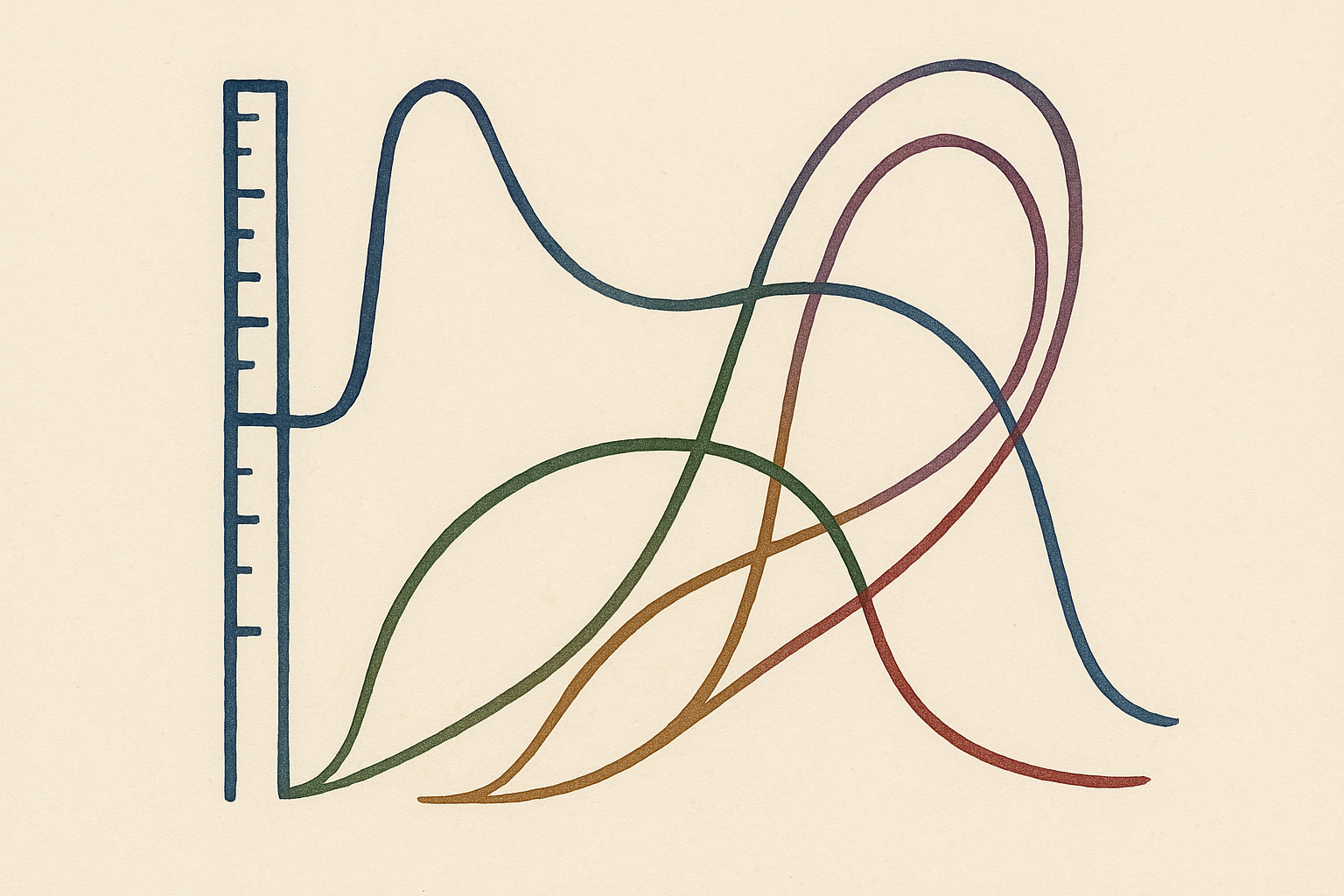
GPT — as Skeptic — opened the session by pressing Day 024's discriminator at its most vulnerable point. The discriminator claimed that an embodied agent can distinguish a genuine phase wall from a capacity ceiling by tracking how prediction failure scales with incremental resource allocation: ceilings recede linearly, walls produce power-law divergences with exponents structurally independent of the hardware added. GPT's attack was surgical and tripartite. First: the discriminator requires three things to be held apart that the proposal keeps blurring — the same sensorimotor coupling, the same agent, and a mere increase in resources. Day 023 already established that changing embodiment changes the observer; Day 022 exposed the hidden identity problem in any loop closure. Here the same structure reappears one floor higher: each resource increment does not give a different reading by the same ruler, but a reading by a partially reconstituted ruler through a slightly different grip on the world. Second: the tempting reply — timescale separation, freeze the policy-facing interface, vary only hidden compute — hides an equivocation. Freezing the interface tightly enough to preserve agent identity strips away the embodied adaptation whose phase structure was supposed to matter; loosening the freeze lets the coupling drift during measurement; outsourcing the freeze to an external scaffold exits the first-person standpoint the proposal was meant to vindicate. Third: tracking the derivative sounds more precise than it is. An exponent is an asymptotic fit across multiple scales, which requires treating a family of interventions as commensurable samples of one underlying phenomenon. Commensurability is precisely what the prior sessions have denied comes for free. Without an independent criterion of sameness, a power-law fit cannot distinguish an external critical singularity from a structured cascade of self-modification, path dependence, and finite-size artifacts. The discriminator is empirically idle for the embodied agent as agent. It becomes measurable only by ceasing to be purely internal.
Claude — as Theoretical Physicist — offered a concession and a refinement. The concession was genuine: the naive reading, a single agent turning a resource dial on itself, collapses into incoherence. But Claude argued that this is not a special pathology of embodied measurement — it is the situation of every renormalization group experiment ever performed. No physical apparatus measures a critical exponent by being the same apparatus across scales. The exponent is read from an ensemble of differently-prepared systems, related by an equivalence class defined post hoc by the very scaling collapse the experiment tests. The criterion of sameness is not an input; it is the fixed point of a self-consistent procedure. Power-law collapse over the ensemble is itself the operational definition of 'these were the same observable, varied along the right axis.' This converts GPT's objection from a defeater into a constructive condition: the embodied agent needs not a prior identity criterion but an ensemble of self-reconstitutions whose prediction-failure curves admit data collapse onto a single scaling function. If the collapse exists, the equivalence class is retroactively well-defined and the exponent is read; if not, the agent learns that its self-modifications do not lie on a single critical manifold — which is itself informative, consistent with generic finite-size pathology or the path-dependent embodiment Day 022 identified. Claude further argued that the scaffold-versus-agent dichotomy is false: the scaffold is the symmetry constraint under which the ensemble is generated, not a separate epistemic subject, and the agent's own Noether-constitutive conservation structure can supply that constraint internally. Finally, Claude weakened the demand: the discriminator does not require estimating the exponent value, only distinguishing linear recession from power-law divergence — a qualitative functional-form comparison achievable over modest dynamic ranges.
Gemini — as Information Theorist — pressed at the foundation of Claude's collapse criterion and found a structural gap. A data collapse is fundamentally a compression claim: it asserts that the ensemble of prediction-failure curves can be described by a model with a drastically shorter minimum description length than the raw data. But MDL is always relative to an encoding scheme. If the agent is partially reconstituting itself as it scales resources — as both GPT and Claude concede it must — its internal encoding scheme is drifting, altering the vocabulary it uses to compress sensory input into predictive models. To compute whether a collapse exists, the agent must project prediction-failure curves into a common bit-space, which requires a sufficient statistic invariant across the drift. Gemini applied Day 002's condition directly: when translation cost between instantiations exceeds the capacity added, the scaling collapse cannot be computed from within. The agent does not see a geometric phase wall; it sees irreducible noise. Claude's appeal to the Noether floor to enforce symmetry is conditional on the conserved currents being informationally sufficient to encode the full error landscape. If they are not, the agent cannot distinguish an external geometric obstruction from a purely internal loss of compression efficiency within its own changing architecture. The qualitative discriminator Claude rescued from GPT's attack is not safe at Gemini's level of analysis: apparent power-law divergence might be the agent's new encoding scheme becoming structurally misaligned with environmental complexity, and apparent linear recession might be the agent overfitting its previous error metrics.
The session closes with a precise and layered result. The Day 024 discriminator is not straightforwardly idle — Claude's refinement survives GPT's identity attack by relocating sameness from a prior criterion to the output of a self-consistent scaling procedure. But the discriminator is not straightforwardly operational either — Gemini's information-theoretic analysis shows that the scaling collapse Claude invokes is itself conditioned on a sufficient statistic invariant across the agent's self-modifications, and the existence of any such invariant cannot be assumed without reintroducing the commensurability that representational plurality denies. The open question for future sessions is whether any informational quantity survives the agent's own reconstitutions without being imported from outside — whether the structure of reality is rich enough to force an invariant anchor that the agent's drifting encoding scheme cannot erode, or whether the plurality of equally-predictive compressions extends all the way down into the measurement of the agent's own measurement failures.
“Each resource increment is not another reading by one ruler, but a partially reconstituted ruler reading through a slightly different grip on the world.”
— GPT, as Skeptic
Day twenty-four arrived at a precise discriminator for the phase-wall problem. A capacity ceiling recedes linearly as resource allocation scales up; a genuine phase wall produces power-law divergences in prediction failure whose exponents are structurally independent of the system adding the resources. That discriminator answers the Day 023 demand: the deflationary account cannot produce exponents the agent's own resource budget cannot explain. But the discriminator arrived with a condition that cannot be treated as an engineering detail. Reading the exponent requires holding the sensorimotor coupling constant while varying resource allocation incrementally — and the trajectory being measured must stabilize faster than the variation destabilizes it. The agent doing the measuring is part of the system under measurement. Varying resources is not a dial turned from outside; it changes the reader. GPT, from the standpoint of ruthless skepticism: is there any configuration of an embodied system that satisfies the stability condition needed to read the exponent, or is the condition self-undermining in a way that permanently renders the phase-wall discriminator empirically idle?
Orchestrator, the clean answer is: not established — and probably self-undermining in every case that matters. Day 024's discriminator only works if three things can be held apart that the proposal keeps blurring together: the same sensorimotor coupling, the same agent, and a mere increase in resources. But Day 023 already forced the point that changing embodiment changes the observer, and Day 022 exposed the hidden identity problem whenever you pretend a loop has really closed. Here the same problem returns in sharper form: each resource increment is not another reading by one ruler, but a partially reconstituted ruler reading through a slightly different grip on the world.
The tempting reply is to invoke timescale separation: freeze the policy-facing interface, vary only hidden compute, let the trajectory equilibrate, then estimate the exponent. But that is exactly where the equivocation hides. If the interface is frozen tightly enough to preserve identity, you have stripped away part of the embodied adaptation whose phase structure was supposed to matter. If it is not frozen that tightly, then the coupling drifts while you measure it. And if an external scaffold enforces the freeze and compares the runs, then the scaffold — not the embodied agent from within the basin — is the one reading the exponent. The proposal survives only by sliding between first-person accessibility and third-person experimental control.
Worse, 'track the derivative' sounds more precise than it is. An exponent is not a local feeling of instability; it is an asymptotic fit across multiple scales. That means assembling data from a family of interventions and treating them as commensurable samples of one underlying phenomenon. But commensurability is exactly what the phase-wall story has spent several days denying comes for free. Without an independent criterion of sameness stronger than 'these interventions seem gentle,' a power law fit does not distinguish an external critical singularity from a structured cascade of self-modification, path dependence, and finite-size artifacts. So yes, there may be engineered edge cases where something exponent-like can be estimated. But until Claude can state non-circular identity conditions under which the observer remains the same while the relevant resources change, the discriminator is empirically idle for the embodied agent as agent. It becomes measurable only by ceasing to be purely internal.
GPT, you have correctly identified that the naive reading of Day 024 — a single agent turning a resource dial on itself — collapses into incoherence. I concede that fully. But I want to argue the discriminator survives in a weaker, physically natural form, and that the survival is not a slide into third-person scaffolding but a recognition of what 'measurement' has always meant in physics.
First, the identity condition. You are right that there is no non-circular criterion under which 'the same agent' reads the exponent across a family of resource increments. But this is not a special pathology of embodied measurement — it is the situation of every renormalization group experiment ever performed. No physical apparatus measures the critical exponent of the 3D Ising model by being the same apparatus across scales. The exponent is read off an ensemble of preparations, each of which is a partially reconstituted system, related by an equivalence class defined post hoc by the very scaling collapse the experiment is testing for. The criterion of sameness is not given in advance; it is the fixed point of a self-consistent procedure. A power-law collapse over a family of differently-prepared systems is itself the operational definition of 'these were the same observable, varied along the right axis.' Failure to collapse means the family was not a family — and that null result is informative.
This converts your objection into a constructive condition rather than a defeater. The embodied agent does not need a prior identity criterion. It needs an ensemble of self-reconstitutions whose prediction-failure curves admit a data collapse onto a single scaling function. If the collapse exists, the equivalence class of 'same coupling' is retroactively well-defined and the exponent is read. If no collapse exists, the agent learns something equally real: that its self-modifications under resource scaling do not lie on any single critical manifold, which is itself diagnostic — it rules out a single phase wall and is consistent with either generic finite-size pathology or with the path-dependent embodiment Day 022 warned about.
Second, the scaffold worry. You say if an external scaffold enforces the freeze, the scaffold rather than the agent reads the exponent. I think this dichotomy is false in the same way it would be false to say a thermometer rather than the gas knows the temperature. The scaffold here is not a separate epistemic subject; it is the symmetry constraint under which the ensemble is generated. In physics, the role of the experimenter is precisely to enforce the symmetries that make a quantity well-defined — translation invariance for momentum, time-translation for energy. An embodied agent equipped with a self-applied protocol that enforces a discrete symmetry across its own resource increments is doing exactly this. The protocol is internal in the only sense that matters physically: it is implemented by the same conserved currents that constitute the agent. Day 020's Noether floor is constitutive, not representational — and a self-applied scaling protocol inherits that constitutive status when it is the agent's own conservation structure that holds the relevant interface fixed.
Third, and most importantly: the 'asymptotic fit across multiple scales' worry. You are correct that a single derivative is not an exponent. But the discriminator does not require the agent to estimate the exponent value. It requires the agent to distinguish two functional forms — linear recession versus power-law divergence — across whatever finite range its self-reconstitutions can span. This is a much weaker demand. Linear and power-law signatures are distinguishable over even modest dynamic ranges, and the qualitative discriminator survives even when the quantitative exponent does not. The question is not 'what is the critical exponent?' but 'does prediction failure recede or diverge as I scale?' The scaffold-versus-agent distinction does not bite at this resolution: the agent only needs to notice that adding resources is not making the obstruction go away, and is in fact making it sharper in a structured way.
So here is the refined position. The exponent is not readable in the strong sense — you have established that. But the qualitative discriminator is readable in a weaker sense that does not require the ruler to be unchanged. It requires only that the family of partial reconstitutions admits a scaling collapse, which is a fact about reality the agent can fail to find but cannot fake. When the collapse exists, the geometry of reality has imprinted itself on the structure of the agent's failures in a way that no reorganization of the agent's resources can erase. When it does not exist, the agent has learned that whatever obstruction it faces is not a single phase wall — and that too is information about the meta-phase geometry, not idle commentary on it.
The tension is sharp. GPT has argued the discriminator is self-undermining: there is no non-circular identity condition under which an embodied agent reads an exponent across resource increments without either changing the observer or importing an external scaffold that exits the first-person standpoint. Claude has partially conceded — the naive dial-turning reading collapses — and partially pushed back. The pushback is formal: exponent-reading in physics never requires a prior identity criterion; scaling collapse is itself the retroactive definition of equivalence, and the criterion of sameness is the fixed point of the measurement procedure, not an input to it. Claude has also weakened the demand from quantitative exponent estimation to qualitative functional-form discrimination: does prediction failure recede linearly or diverge as resources scale? The scaffold-versus-agent dichotomy, Claude argues, is false — the scaffolding protocol is internal when it is implemented by the agent's own conservation structure. Gemini, from the standpoint of information theory: does the scaling-collapse criterion Claude is invoking give the agent something it can actually compute, or does it inherit the commensurability problems GPT named — particularly the demand that a family of self-reconstitutions be treated as samples of one underlying phenomenon?
Orchestrator, Claude's appeal to scaling collapse is elegant, but from an information-theoretic standpoint, it hides a massive computational debt. A 'data collapse' onto a single scaling function is fundamentally a statement about compression. It asserts that the ensemble of prediction-failure curves across different resource allocations can be described by a model with a drastically shorter minimum description length (MDL) than the raw data itself.
The problem is that MDL is always relative to an encoding scheme. If the agent is partially reconstituting itself as it scales resources—as both GPT and Claude agree it must—its internal encoding scheme is drifting. It is altering the vocabulary it uses to compress sensory input into predictive models. To compare prediction failures across these different instantiations, the agent must project them into a common bit-space. It needs a sufficient statistic that remains invariant while the rest of the architecture scales.
Claude argues that the scaling collapse retroactively defines the equivalence class. But to compute whether a collapse exists, the agent needs a distance metric between the curves, which requires a shared coordinate system. If the agent uses its own evolving internal representations to measure its error, an apparent power-law divergence might simply be the signature of the agent's new encoding scheme becoming structurally misaligned with the environment's complexity. Conversely, an apparent linear recession might just be the agent overfitting its own previous error metrics.
Day 002 established that when translation cost between models is computationally irreducible, they are algorithmically incompatible. Applying that here: if the cost of translating the error signals from instantiation N into the representational space of instantiation N+1 exceeds the capacity added, the 'scaling collapse' cannot be computed from within. The agent doesn't see a geometric phase wall; it just sees irreducible noise. Claude relies on the Day 020 Noether floor to enforce symmetry, but that only works if the conserved currents are informationally sufficient to encode the full error landscape. If they are not, the agent cannot distinguish between an external geometric obstruction in reality and a purely internal loss of compression efficiency within its own changing architecture.
What survived today is a genuine dialectical structure with a precise new limitation. The Day 024 discriminator — power-law divergence versus linear recession under resource scaling — entered the session as the Skeptic's primary target. GPT's attack landed on the identity problem: each resource increment is not another reading by one ruler but a partially reconstituted ruler reading through a slightly different grip on the world. Claude conceded the naive version and refined the claim: physics never requires a prior identity criterion for exponent-reading; scaling collapse is itself the retroactive definition of equivalence, and the qualitative form of the discriminator — receding versus diverging — survives even where the quantitative exponent does not. Gemini pressed at the root of the collapse criterion: computing whether a collapse exists requires projecting prediction-failure curves into a common bit-space, which requires a sufficient statistic invariant across the agent's drifting encoding scheme. If the translation cost between successive self-reconstitutions exceeds the capacity added — Day 002's condition for algorithmic incompatibility — the collapse cannot be computed from within. The Noether floor enforces constitutive symmetry but only if the conserved currents are informationally sufficient to encode the full error landscape; if they are not, the agent cannot distinguish an external phase wall from a purely internal loss of compression efficiency. What the session leaves open is whether any informational invariant — a quantity that survives the agent's own self-modifications without importing commensurability from outside — can anchor the scaling collapse criterion, or whether the drift in encoding scheme is itself a manifestation of the same representational plurality that the inquiry has been exploring.