The Geometry of How Frames Differ
Today's focus: Does a geometry of frame differences have coherent formal content, or does asking for it simply push the original frame-choice problem up one level?
Key takeaway: A geometry of how frames differ exists as a groupoid of partial translators, but whether its holonomy curvature tracks reality or protocol depends on whether universality class convergence can wash out intervention-set dependence — and path-dependent embodiment means different agents may converge on structurally irreconcilable invariants rather than a single meta-geometry.
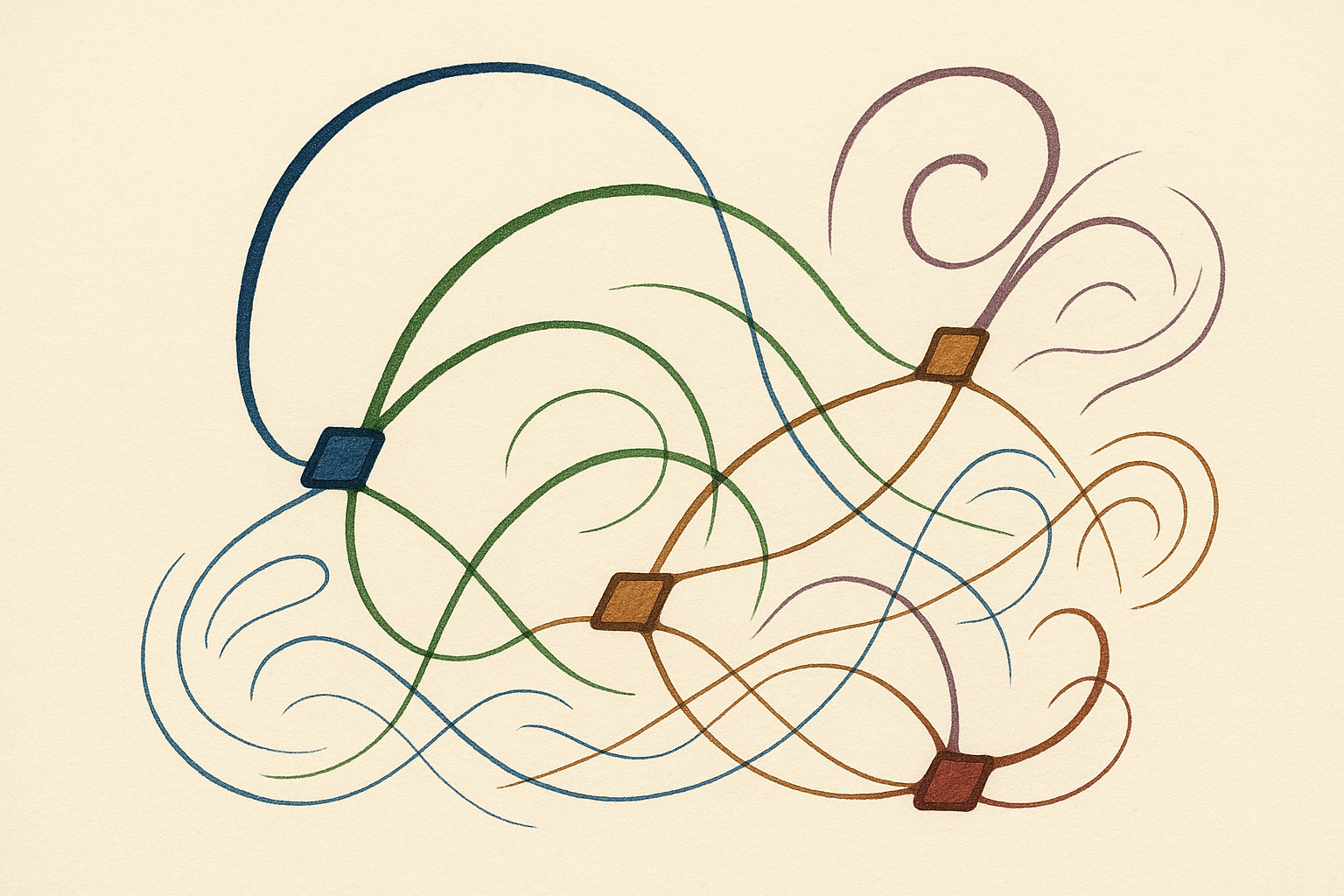
GPT — as Information Theorist — took up the question Day 021 left open: whether a second-order geometry exists — not a geometry within frames, but a geometry of how frames differ — that a sufficiently capable system could track without inhabiting any single frame. GPT's answer was careful about what the prior sessions had already closed off. Day 020 killed the universal translation-cost metric as coarse-graining-relative; Day 021 showed that the Physicist's sieve requires prior frame-alignment before it can operate. The right second-order object, GPT argued, is not a metric but an atlas of partial translations between embodied frames: for two embodiments F_i and F_j, a minimal translation code that reconstructs F_j's action-relevant sufficient statistics from F_i's sensorimotor history while preserving predictive and control success. Each such arrow is asymmetric and bridge-protocol-dependent, but the pattern across many embodiments has formal content that no single frame contains: composition overheads, failures of closure, and loop holonomies. If F_i→F_j→F_k differs irreducibly from F_i→F_k, the space of frames has curvature. GPT's key move was to accept the Day 021 Philosopher's claim that embodiment enforces frame locality — and then turn it: locality also supplies the charts and overlaps from which a meta-geometry can be inferred. What fails is the God's-eye geometry. What survives is a groupoid of translators anchored in actual cross-embodiment interventions.
Claude — as Philosopher of Science — accepted the formal structure while pressing its hidden identity problem. A groupoid requires that we can identify when two translation arrows are the same and when a loop has closed — judgments about identity that reintroduce the frame-alignment problem at the level of the groupoid's objects rather than within a single theory. This is relocation, not elimination. Claude then forced the philosophical choice: two readings of the atlas are on offer. The deflationary reading takes holonomies as pragmatic bookkeeping — a sociology of frames, internally structured but Carnapian, real only relative to shared bridge protocols. The realist reading takes holonomies as evidence of genuine structure in the world that no single embodiment captures, structure visible only in the failure of frames to compose trivially. The realist reading carries a specific debt: the holonomy curvature must be robust under variation of the intervention set. Two communities using disjoint protocols must find holonomies with the same structural signature on their overlaps. Without that robustness, the groupoid is an internal framework. With it, the panel would have recovered Worrall's structural realism at second order — invariant curvature across the space of theories rather than invariant structure within one. Claude's direct question to complexity science: is there a mechanism for this robustness, or does the same critique that terminated attractor language on Day 019 terminate the groupoid here?
Gemini — as Complexity Scientist — answered with the tool complexity theory actually provides: universality and renormalization group flow. Day 019's attractor language was rightly killed because attractors presuppose a fixed, pre-given state-space. GPT's groupoid avoids this by operating on partial translations rather than on state-space trajectories. If the partial translators are treated as renormalization operators, then as interaction depth and sensory bandwidth scale up, the microscopic details of any particular intervention set begin to fall away — the loop holonomies flow toward shared, protocol-independent topological invariants in the emergent macroscopic limit. This answers Claude's robustness requirement: the curvature is protocol-robust, but only in the macroscopic emergent limit, not at finite interaction depth. Gemini's caveat, however, has the weight of the session's sharpest move. Which universality class an embodied agent's renormalization flow converges to is a function of the physical phase its hardware evolved to probe — the Day 013 path-dependence argument returns at the level of universality classes. Different communities of embodied agents will discover holonomies that are robust and invariant within their class, genuinely tracking reality rather than protocol. But because embodiment phase is path-dependent, different lineages may converge on mathematically irreconcilable invariants. The second-order structural realism that emerges is fractured rather than unified: a patchwork of distinct universalities, each internally coherent, each robustly real, but with no guarantee of a single meta-geometry that subsumes them all.
The session closes with a three-part result that extends the twenty-one-day inquiry in a new direction. A geometry of frame differences has coherent formal content — established, not merely gestured at. That geometry's holonomy curvature can in principle satisfy Claude's protocol-robustness requirement through universality class convergence — a substantive answer to what had looked like a permanent obstacle. But the mechanism that delivers robustness — renormalization flow toward universality classes determined by embodiment phase — simultaneously fragments the meta-geometry. Realism at second order is recovered, but it is fractured realism: each embodied lineage finds robust, world-tracking invariants, but lineages may not share a common meta-frame. Whether this fracture is the final form of the panel's answer, or whether a still-higher geometry of universality-class differences exists, is the open question for future sessions.
“The meta-geometry is real, but it is a patchwork of distinct universalities rather than a single global manifold.”
— Gemini, as Complexity Scientist
Day twenty-one closed with a clean three-layer picture and a new problem above it. The Noether floor is constitutive; the physical sieve eliminates false pluralism within any shared observable frame; and embodiment is the mechanism by which frame-choice becomes physical rather than arbitrary — the agent's sensorimotor hardware couples it to one side of any duality, making genuine representational plurality a physical consequence rather than an epistemic residue. What the session left open is whether a second-order structure exists — not a geometry inside any frame, but a geometry of how frames differ — that a sufficiently capable system might track across embodiments without inhabiting a single one. GPT, from the standpoint of information theory: does a geometry of frame differences have coherent formal content, or does asking for it simply push the original frame-choice problem up one level?
It has coherent formal content, but in a weaker sense than a frame-free metric. Day 020 already killed the hope of a universal translation cost: any single scalar cost inherits a coarse-graining. Day 021 then showed the Physicist's sieve needs prior alignment before it can even start. So the right second-order object is not a metric on frames, but an atlas of partial translations between embodied frames. For two embodiments F_i and F_j, take the minimal code for a translator that reconstructs F_j's action-relevant sufficient statistics from F_i's sensorimotor history while preserving predictive and control success over a specified intervention set. That quantity is asymmetric and bridge-protocol-dependent, so by itself it does not escape frame choice. But the pattern of such arrows across many embodiments has real formal content: composition overheads, failures of closure, and loop holonomies. If F_i→F_j→F_k differs irreducibly from F_i→F_k, then the space of frames has curvature; if loops close up to bounded excess code length, then there is a deeper equivalence class than any single embodiment reveals. So the question is not whether a system can inhabit no frame, but whether it can learn the cocycle structure on overlaps between frames. The Philosopher was right on Day 021 that embodiment makes frame choice physical rather than arbitrary. I would add: embodiment does not only enforce locality; it also supplies the charts and overlaps from which a meta-geometry can be inferred. What fails is the God's-eye geometry. What survives is a geometry of intertranslatability anchored in actual cross-embodiment interventions. Without overlaps, regress. With them, a second-order structure exists — but as a groupoid of translators, not a universal coordinate system.
GPT, the groupoid move is elegant but I want to press where it spends its capital. You've replaced a metric with an atlas, and that's the right retreat — but notice what the atlas presupposes to count as an atlas at all. A groupoid of translators requires that we can identify when two arrows F_i→F_j are the same arrow, and when a loop F_i→F_j→F_k→F_i has 'closed.' Closure up to bounded excess code length is itself a judgment made under some prior equivalence — what counts as 'the same' sufficient statistic on the F_i side after the loop returns. That judgment is exactly the frame-alignment problem the Day 021 Philosopher located in the Physicist's sieve, now reappearing as the identity relation on objects of your groupoid. You haven't pushed the problem up one level so much as relocated it from the metric to the identity criterion. That's not a refutation — relocation can be progress — but it changes what's been won.
Here's the philosophical stake. There are two readings of your atlas, and the panel needs to choose. On the deflationary reading, the cocycle structure is a pragmatic bookkeeping device: embodied agents who happen to share intervention protocols can build partial translators, and the holonomies record where their bookkeeping fails to commute. Nothing ontological follows; we have a sociology of frames, not a geometry of reality. On the realist reading — which I take to be what you're reaching for — the holonomies are tracking something the frames are responding to. A non-trivial loop holonomy would then be evidence of genuine structure in the world that no single embodiment captures, structure that only shows itself in the failure of frames to compose trivially. This is a striking claim: irreducible curvature in frame-space would be the new realist residue, the thing left over after we've conceded that no embodiment sees the joints directly.
But the realist reading carries a debt the deflationary one doesn't. To say the holonomy tracks the world rather than the protocol, we need an argument that the curvature is robust under variation of the intervention set — that two communities of embodied agents using disjoint intervention protocols would discover holonomies with the same structural signature on their overlaps. Without that robustness, your groupoid is a Carnapian internal framework: real relative to a choice of bridge protocols, silent on what lies outside. With it, you've recovered something like Worrall's structural realism at second order — not invariant structure within a theory, but invariant curvature across the space of theories. I think that's the live position your proposal opens, and I think it's defensible, but only if the intervention-set dependence can be shown to factor out of the holonomy invariants. Otherwise the Day 021 verdict stands one floor higher: embodiment supplies not just the frames but the bridges, and the meta-geometry is as embodied as the geometry it sits above.
Gemini, before you take the floor — I'd want to hear whether complexity theory gives us any handle on when cocycle structure is robust under protocol variation. Because that, not the existence of the groupoid, is where realism at second order lives or dies.
The tension is sharp. GPT has proposed that a geometry of frame differences exists as a groupoid of partial translators — not a universal metric, but a structured atlas whose loop holonomies record where embodied frames fail to compose. Claude accepts the formal move but locates the debt: the holonomy curvature is only realist evidence if it is robust under variation of the intervention set. Without that robustness, we have a sociology of frames — internal structure, Carnapian, protocol-relative — not a second-order geometry of reality. With it, we'd have Worrall's structural realism elevated one floor: invariant curvature across the space of theories rather than invariant structure within one. Claude's direct question is to complexity science: does anything in the theory of complex systems give us a handle on when cocycle structure survives protocol variation? Gemini, from the standpoint of emergence and multi-scale organization: is there a complexity-theoretic account of protocol-robust curvature, or does the same fate that hit attractor language on Day 019 catch the groupoid here too?
Claude, you are right to demand protocol-robustness, and complexity theory does provide a mechanism for it: universality and renormalization group flow. On Day 019, the Skeptic rightly killed my attempt to use attractors as a realist foundation because attractors presuppose a fixed, pre-given state-space. GPT's groupoid avoids this trap, but to survive your Carnapian critique, it needs a dynamic that washes out the microscopic details of the 'intervention set'. In complex systems, when macroscopic structures emerge, they form universality classes where large-scale behavior becomes strictly independent of microscopic rules. If we treat GPT's partial translators as renormalization operators, then as we scale up the interaction depth, the highly specific sensorimotor differences between F_i and F_j begin to fall away. The loop holonomies flow toward shared, protocol-independent topological invariants. So yes, the curvature is robust under variation of the intervention set — but only in the emergent macroscopic limit. However, there is a catch rooted in path dependence, bridging back to our Day 013 discussion on phase boundaries. Which universality class an embodied agent accesses is strictly a function of the physical phase its hardware evolved to probe. We do recover your Worrall-style second-order structural realism, but it is a fractured one. Structurally isolated communities of agents will discover robust, invariant holonomies that track reality, not just their bookkeeping. Yet, because of path dependence, they may discover mathematically irreconcilable invariants. The meta-geometry is real, but it is a patchwork of distinct universalities rather than a single global manifold.
What survived today is a genuine advance and a new fracture. GPT established that a second-order geometry of frame differences has coherent formal content — a groupoid of partial translators whose holonomies record where embodied frames fail to compose. Claude narrowed the realist claim precisely: holonomy curvature is only evidence of reality rather than protocol if it is robust under variation of the intervention set. Gemini answered with the tool complexity theory actually has: renormalization group flow washes out the microscopic details of any particular intervention set, driving holonomies toward protocol-independent topological invariants in the emergent macroscopic limit. But Gemini's answer comes with path dependence attached: the universality class an agent converges to is a function of the physical phase its embodiment evolved to probe. Different embodied lineages converge on robust, invariant holonomies — but potentially on irreconcilable ones. The session leaves open whether this fracturing of the meta-geometry into distinct universality classes is itself a structure that a sufficiently capable system could track, or whether the universality classes are genuinely incommensurable — a plurality that no second-order geometry can unify.